


- WordPress shipped an emergency security release, 7.0.3, on 6 August. The headline flaw is a scripting vulnerability on the login screen that needs no account to trigger.
- Researchers demonstrated a chain from that flaw to code execution on the server, but the chain needs a logged-in administrator to interact with an attacker-controlled page. It is not a single unauthenticated request.
- The release fixes twelve issues in total, including a privilege escalation on multisite networks and a server-side request forgery. Only one of them was reported widely.
- Much coverage said every version is affected. WordPress’s own note describes backports to branches still eligible for fixes, and independent analysis narrows the exploitable range further.
- Sites with automatic background updates should already have the fix. Sites on older branches may still be waiting, because backports were in progress when the release shipped.
- No confirmed exploitation had been reported at the time of writing, but the technique is public.
WordPress published version 7.0.3 on 6 August as a security release, urging site owners to update immediately. The most serious of the twelve issues it addresses is a pre-authentication reflected cross-site scripting flaw on the login screen, reported by the team at pwn.ai, which the project says has the potential to lead to PHP code execution. It is tracked as CVE-2026-64638.
What the flaw is
The vulnerability sits in how the login screen renders an error after a failed sign-in attempt. Because that screen is reachable by anyone, the first stage requires no account and no prior access.
The escalation to code execution is where precision matters. Per the project’s advisory, reaching that outcome additionally requires successful social engineering of a target and explicit interaction from them, with the researchers’ demonstration relying on an administrator who is already signed in visiting an attacker-controlled page. That is a meaningfully different risk profile from a flaw that can be exploited by sending a single request to a server, and several summaries have collapsed the two.
The distinction is not pedantry. It changes who is exposed, how quickly mass exploitation could plausibly occur, and what compensating controls help while patching is in progress.
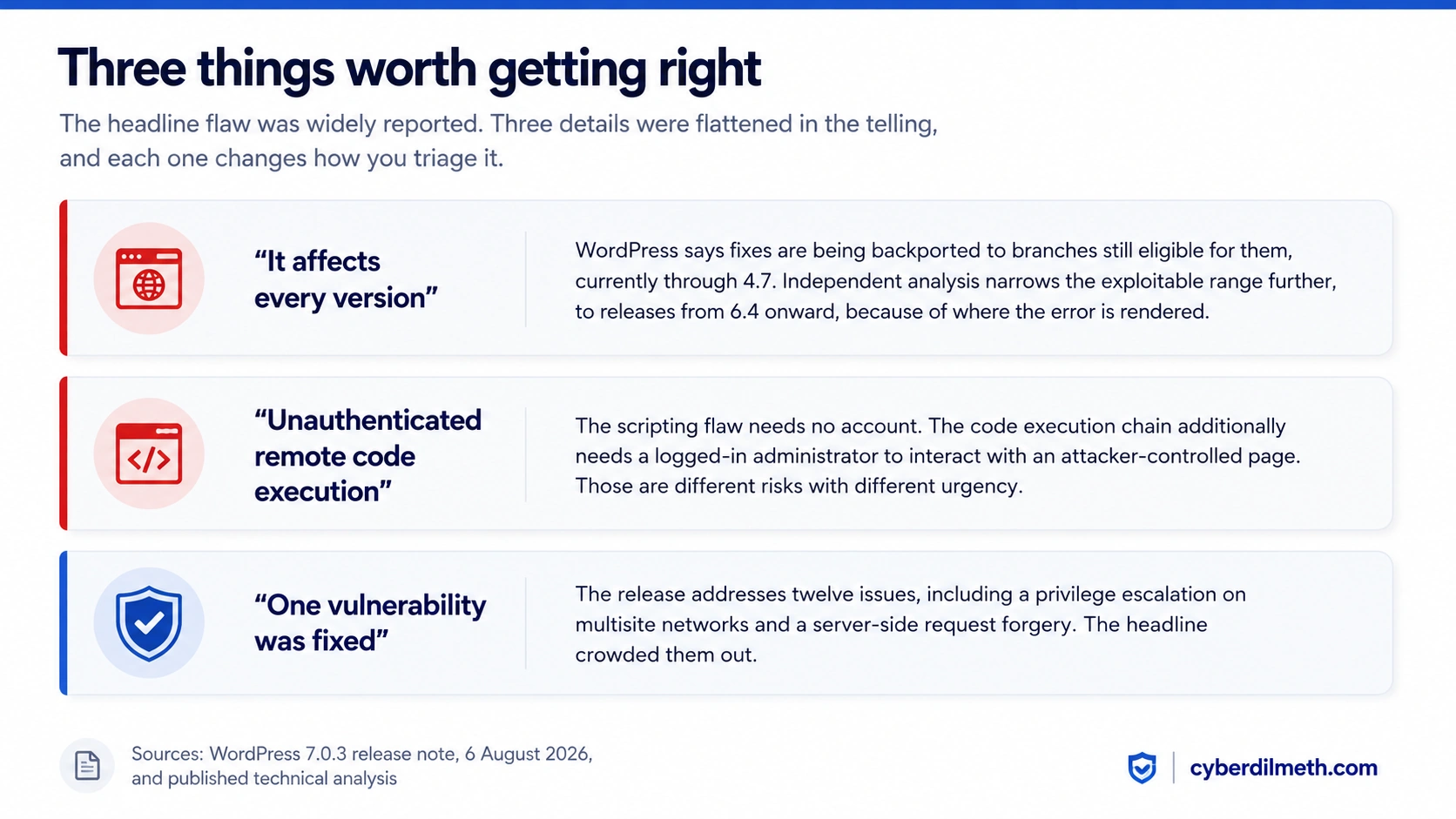
On affected versions, the widely repeated claim is that every version of WordPress is affected. The project’s own release note says something more specific: fixes are being backported, where necessary, to all branches still eligible to receive security fixes, currently through 4.7, and it reminds readers that only the most recent version is actively supported. Separately, published technical analysis argues the exploitable range begins at 6.4, because the login error path only passes through the relevant rendering step from that release onward. We have not independently reproduced that analysis, and the safe operational position remains to update regardless of branch.
On severity framing, the flaw is rated high rather than critical. That is a reasonable rating for a scripting issue whose most serious outcome is conditional, and it is worth defending against internal pressure to treat every headline as a critical.
On scope, the release fixed twelve issues, and the coverage almost entirely concerned one.
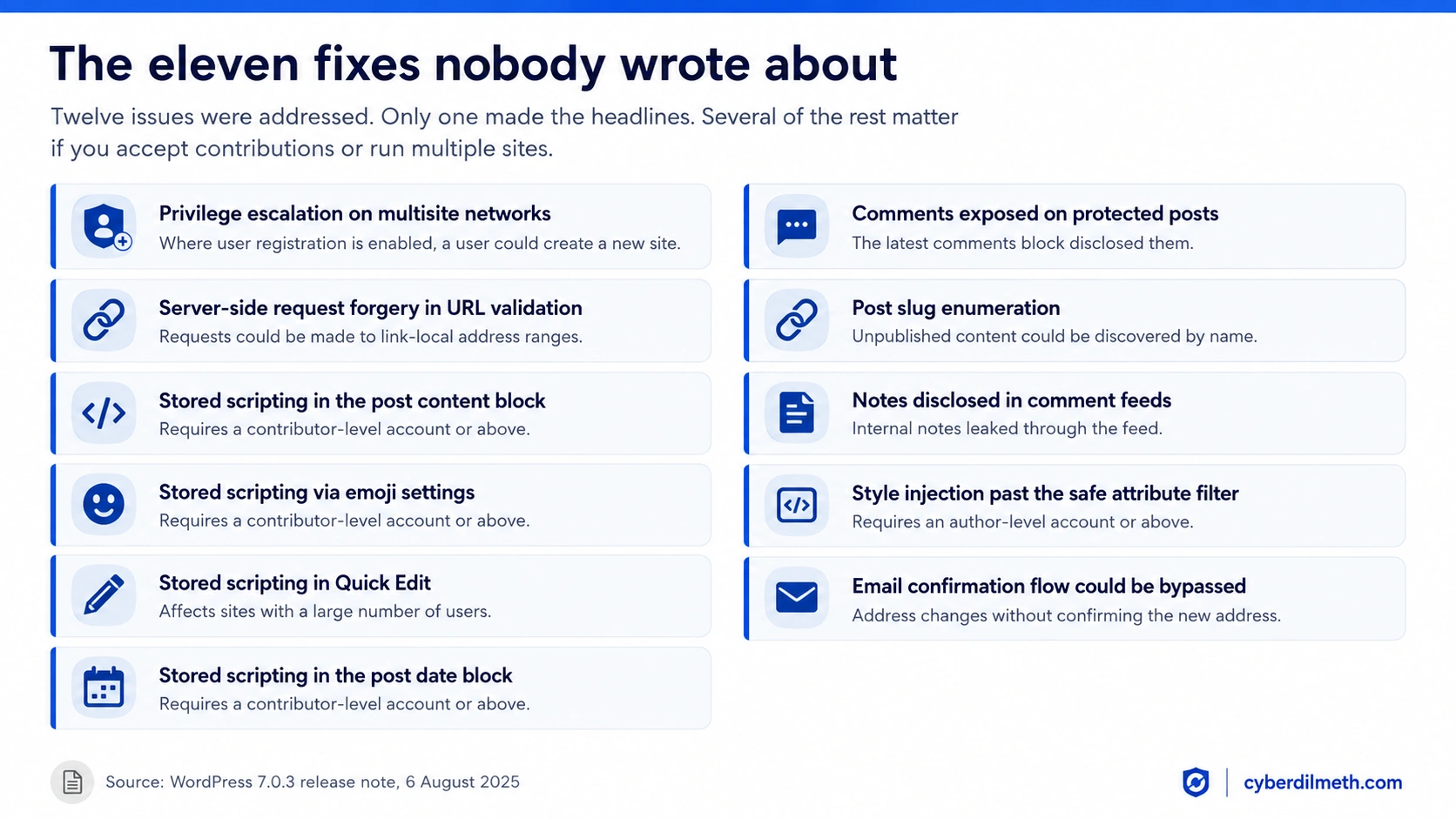
Two deserve attention in their own right. There is a privilege escalation on multisite networks with user registration enabled, allowing a user to create a new site. And there is a server-side request forgery in URL validation permitting requests to link-local address ranges, a class of issue that matters disproportionately on cloud-hosted infrastructure where those ranges can expose instance metadata.
Several of the remaining fixes address stored scripting reachable by accounts with contributor-level access or above. If your site accepts contributions from people you do not directly control, and many publishing sites do, those are more relevant to you than the login-screen flaw.
What to do
Sites configured for automatic background updates should have received the fix already, and confirming that is a two-minute check rather than an assumption worth making. Sites on older branches may still be waiting, because the release note records the backports as in progress at the time of publication.
Where an immediate update is not possible, the exposure can be reduced by restricting access to the login screen, either by address or by placing it behind an existing access control, which removes the pre-authentication surface entirely. A content security policy limits what injected script can do and is worth having regardless of this particular flaw.
The other half is the escalation path. Because the demonstrated chain depends on an administrator being signed in and interacting with an attacker-controlled page, reducing the number of accounts holding administrator rights, and not browsing generally while signed in as one, are both meaningful reductions rather than platitudes.
Why it matters
For anyone who runs a website, this is a reminder that the platform itself needs patching, not only its plugins. Plugin vulnerabilities are far more common, which has trained a lot of site owners to think of core updates as feature releases they can defer. This one is a security release, and the correct response is to install it today rather than at the next convenient moment.
For organisations, the useful question is not whether someone patched but whether anyone owns the website at all. Marketing sites are frequently built by an agency, handed over, and then maintained by nobody in particular, which is exactly how an unpatched public-facing application persists for years. If your organisation cannot name the person responsible for updating its website within a minute, that is the finding rather than the vulnerability.
For practitioners, two things follow. The first is a triage discipline: read the vendor’s own advisory before acting on aggregated coverage, because the compression that happens in retelling systematically removes the conditions that determine urgency. In this case, three separate details were flattened, all in the direction of making the flaw sound worse and simpler than it is. The second is that a headline flaw crowds out everything shipped alongside it. Release notes are short and reading them is faster than reading the coverage.
- Check the WordPress version on every site your organisation runs, including ones built by agencies and long-forgotten campaign sites.
- Update to 7.0.3, or to the patched build for your branch if you are on an older supported release.
- Confirm automatic background updates are enabled, rather than assuming they are.
- If you cannot update immediately, restrict access to the login screen by address or place it behind existing access controls.
- Review how many accounts hold administrator rights, and remove those that do not need them.
- If your site accepts contributor-level accounts, treat the stored scripting fixes in this release as the priority rather than the headline flaw.
- If you run a multisite network with user registration enabled, prioritise this update.
- Name the person responsible for your organisation’s website updates, in writing, if that person does not currently exist.
Last verified: 10 August 2026 against the WordPress 7.0.3 release note. No confirmed in-the-wild exploitation had been reported at the time of writing, and backports to older branches were still in progress when the release shipped.