


NVIDIA and 36 other companies launched the Open Secure AI Alliance on 27 July 2026, a coalition to build and share open tools for securing AI agents. Founding members include Microsoft, IBM, Cisco, Cloudflare, CrowdStrike, Palo Alto Networks, Red Hat, Hugging Face and the Linux Foundation. The group released its first open-source project at launch and urged regulators to treat open AI security tooling as a defensive asset rather than a risk.
What happened
The alliance rests on a single argument: cyber defenders need AI systems they can inspect, adapt and run on their own hardware, not only closed services reached through a vendor’s interface. Its stated scope is the full “agent stack”, which the group defines as identity, permissions, harnesses, guardrails, logging and evaluation, rather than the model weights alone.
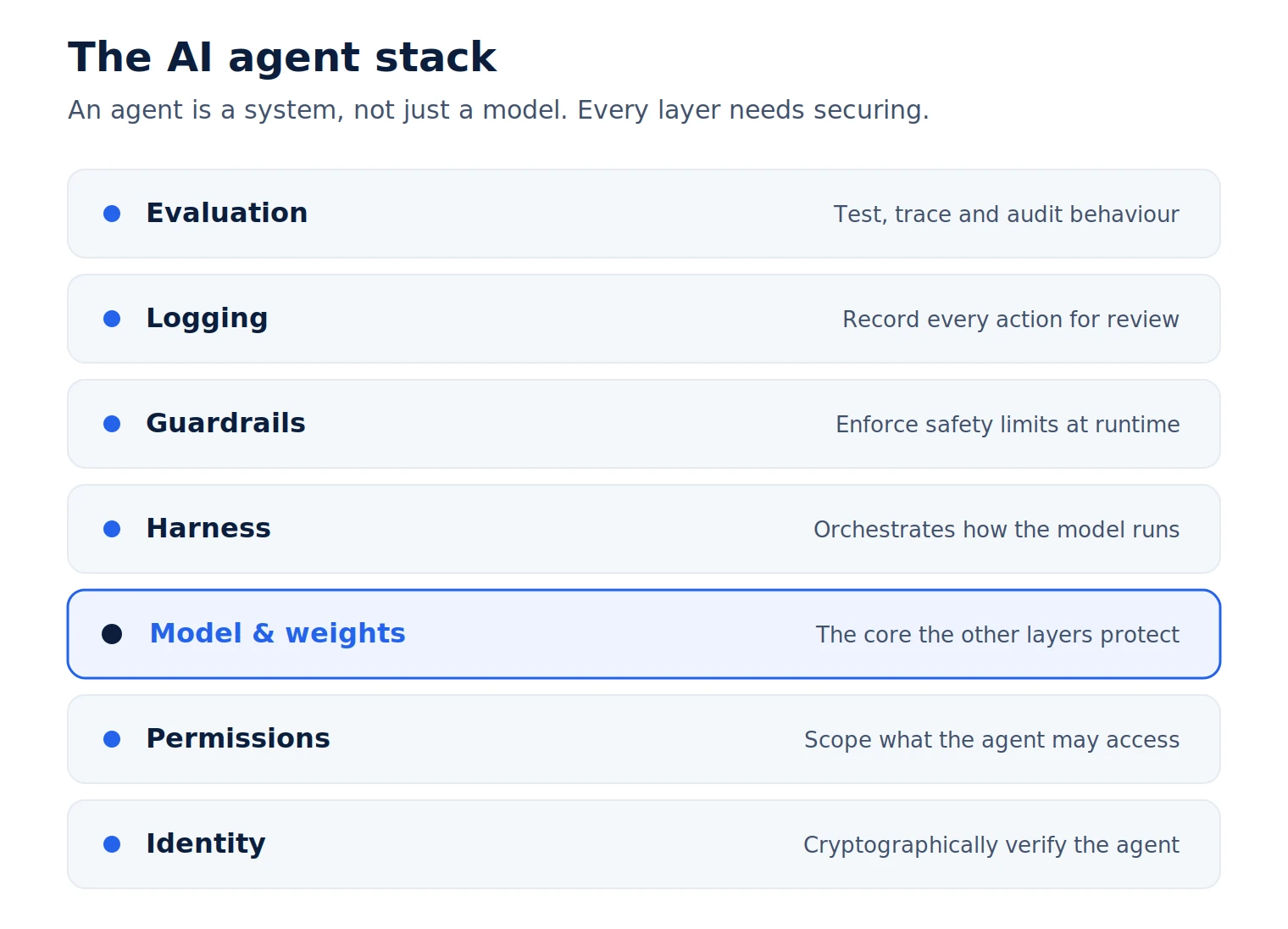
NVIDIA contributed the first named project, the NVIDIA Labs Object-Oriented Agent (NOOA) framework, released on GitHub under an Apache 2.0 licence. NOOA lets developers treat AI agents more like ordinary software so their behaviour can be tested, traced, audited and governed. Other members pledged complementary pieces of an open defence stack: Microsoft’s MDASH, a multi-model harness that coordinates AI agents to find and prove exploitable bugs; Hugging Face’s Safetensors, a model-weight format designed to prevent remote code execution, now offered to the PyTorch Foundation; HPE’s work on SPIFFE/SPIRE for cryptographic agent identity; and a joint IBM and Red Hat effort, Lightwell, that signs open-source patches across the supply chain.
The alliance builds on existing open-source security work, including the Linux Foundation’s Akrites initiative and the OpenSSF community.
Context
The launch follows a run of high-profile incidents involving autonomous AI. NVIDIA’s announcement points to a July 2026 breach at Hugging Face in which closed AI tools could not tell attacker activity apart from defender activity and blocked forensic analysis. Hugging Face said it ran an open-weight model on its own infrastructure to review more than 17,000 actions and contain the intrusion. The alliance uses that episode to argue that defenders lose ground when they cannot examine and control the AI they depend on at the moment speed matters most.
The effort is also a policy campaign. It asks governments and regulators to recognise open models, harnesses and security tooling as defensive assets, and warns that blanket restrictions on open frontier AI could concentrate capability in a handful of closed providers. Independent coverage flagged a caveat worth keeping in view: at launch the coalition published a roster and a position, but little detail on governance, shared workstreams or who maintains the joint code. Whether it ships durable tools, rather than a statement of intent, will be the real test.
For readers newer to this area, our AI Security section explains how AI agents differ from ordinary software and why securing them takes more than guarding the model.
Why it matters
For most individuals there is nothing to install or change today; this is a shift among the companies that build the software you use, and the habit that still protects you is keeping your devices and apps updated. For organisations adopting AI assistants or agents, the signal is that AI security standards are forming right now, so it is worth asking vendors how agent identity, permissions, logging and model integrity are handled, and weighing how open and inspectable each option is, rather than treating “AI safety” as a property of the model alone. For security teams, several artefacts are already worth evaluating: NOOA for agent testing and auditing, Microsoft’s MDASH for multi-model bug discovery, Safetensors for safer model-weight handling, SPIFFE/SPIRE for agent identity, and signed-patch supply-chain work. The principle running through all of it is practical: govern agents as software, with identity, isolation, logging and evaluation, not as opaque models, and track the alliance’s governance maturity before committing to its output.